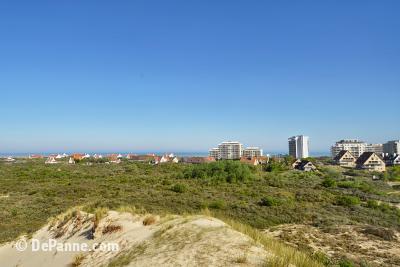
The Dumontwijk is the oldest villa district in De Panne, where architect Albert Dumont designed a resort full of fairy-tale cottages among the dunes around 1900.
The Dumontwijk is the first phase in which De Panne grew from a fishing village into a seaside resort, and it was built entirely on private initiative.
The Zeelaan (around 1892): around 1892 contractor Arthur Bonzel built the Zeelaan from the village to the beach, curving around the Kykhill dune. As payment he received part of the dunes.
A first building wave (1892 to 1913): led by Albert Dumont, assisted by the architects Georges Hobé and Jozef Viérin, a new resort rose among the dunes.
The layout plan (1902 to 1904): his son Alexis Dumont drew up the plan for the new De Panne. Between 1903 and 1908 some 68 villas, eleven hotels and inns and fifteen shops were built.
The English garden city as a model: the district follows the relief of the dunes, with winding streets and paths as in a romantic English garden. The social ideal of the garden city did, however, give way to elegant holiday villas for the well-to-do.
Growth after 1906: in 1906 the district was extended westwards, with the Duinkerkelaan curving around the Witte Berg. A horse tram already ran from Adinkerke station to De Panne in 1901, and a wooden casino was built on the Zeedijk in 1905.
Protected townscape: since 1995 the Dumontwijk has been protected as a townscape. Along the Zeedijk and the main streets, however, much of the original architecture made way for apartment blocks after the Second World War.
Albert and Alexis Dumont
The district is named after the Brussels architect Albert Dumont, who shaped the face of De Panne together with his eldest son.
Albert Dumont (1853 to 1920): born in Neufchâteau, he studied law and philosophy in Ghent and was largely self-taught as an architect. He settled in Brussels at the age of 23.
Father and son: from 1899 his eldest son Alexis Dumont worked with him in De Panne, and they designed many villas together.
Elsewhere on the coast: in Middelkerke Albert Dumont built some two hundred villas in less than fifteen years, and he also drew up a layout plan for Hardelot-Plage in France.
His own villa: on the corner of the Visserslaan and the Hoge Duinenlaan stood Dumont's own Villa Bleue, the focal point of one of the district's sight lines. It has since been demolished.
The sand yacht: on the wide beach the Dumont brothers introduced the sand yacht in 1898, for which De Panne is still famous.
Building styles in the Dumontwijk
A walk through the district reveals a colourful mix of styles from the late 19th century to after the Second World War.
Cottage style (1890 to 1930): rural houses set into the dunes, with painted woodwork, a playful roofscape, red tiles and English and Norman influences such as mock half-timbering. White and green were the favourite colours.
Simple inside: as the cottages were summer homes, their interiors are plain. Pitch pine, a resinous wood, gives them warmth, and changes in level make for a clever layout.
Art nouveau and art deco: flowing lines and floral motifs betray art nouveau, geometric shapes and zigzag motifs the art deco of the interwar years.
Modernism: after 1920 sleek villas with flat roofs, rounded corners and large windows appeared too, such as Villa Nano-Nanine.
Eclecticism: many villas combine elements of different styles, resulting in idiosyncratic designs such as Villa Beau-Séjour with its crenellated corner tower.
Walking route through the Dumontwijk
Twelve villas and buildings that together tell the story of the Dumontwijk, from the church on the Zeelaan to the villas on the Zeedijk.
Onze-Lieve-Vrouwekerk; Zeelaan 129
This neo-Romanesque church with its sturdy tower was built between 1930 and 1932 to designs by Jozef Viérin and his son Luc.
Former Hotel Central; Zeelaan 95
The 1927 hotel by Henri Lepoudre shows the influence of art nouveau, with floral motifs and flowing lines on its facades.
Koning Albertplein
On the square stands the semi-detached pair Les Eglantines and Les Argousiers (around 1900) by Georges Hobé, with mock half-timbering and a separate cellar entrance for the staff.
Villa Kykhill; Hoge Duinenlaan 2A Georges Hobé designed this cottage in 1897 as his own home, on the highest dune in the district. Each of its four facades is different. The Kykhillpark surrounds it.
Villa Beau-Séjour; Thiriarweg 3
An eclectic villa from around 1895 by Albert and Alexis Dumont, with a fairy-tale crenellated corner tower in yellow brick.
Villa Zonneweelde; Albert Dumontlaan 18
This 1913 cottage villa by father and son Dumont has a living room on the raised ground floor that is a complete work of art full of art nouveau.
Villa Nano-Nanine; Albert Dumontlaan 26
A few doors along, this modernist villa from 1936 by Louis Legein makes a striking contrast, with a corner tower topped by a disc and portholes like a ship.
Villa Kinkankhoorn; Visserslaan 47
Built around 1897 for the sculptor Jules Lagae. The lopsided pitched roof refers to the traditional fishermen's cottages of De Panne.
Le Chalutier; Bortierlaan 25
This 1927 studio house by Myriam Dumont and Gustave Remy has an octagonal studio with a large skylight and has been a protected monument since 2002.
Villa Doudou; Zeedijk 55
A cottage villa from 1901 by Albert and Alexis Dumont, whose front door on the raised ground floor opens straight into the living room. One of the few villas still standing on the promenade.
Villa L'Escale; Zeedijk 73
This villa from 1923-1924 by Jean-Jules Eggericx combines the cottage style with art deco, with original Winckelmans tiles. It has been restored and is now a hotel.
Coup de Vent; Zeedijk 81-85
In this group of villas from around 1900, largely by Albert and Alexis Dumont, Coup de Vent stands out with its rounded corner tower that serves as a small belvedere. The villas continue into the Geitenweg.
About this route
A walk through the dunes between the villas, easy to combine with a breath of fresh air on the Zeedijk.
Distance and duration: allow about 3 kilometres and an hour and a half, with time to take in the villas.
Notice the relief: the streets follow the dunes. Between the Albert Dumontlaan and the Zeelaan, narrow winding paths climb the high dune flank.
Respect the residents: almost all the villas are private or holiday homes. Please view them from the street.
By tram: De Panne is the terminus of the Coastal Tram, so you can easily combine the walk with a visit to other resorts on the coast.
Further reading: the book De Dumontwijk, erfgoedparel van De Panne, with old postcards and residents' stories, was published in 2024.
Want to see more
Around the Dumontwijk lie more places from the history of De Panne.
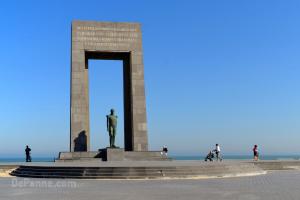
Statue of Leopold I: at the western end of the Zeedijk, the statue of King Leopold I recalls his arrival in 1831.
History of De Panne: from the fishing hamlet of Kerckepanne to the First World War, read all about it on the page about the history of De Panne.