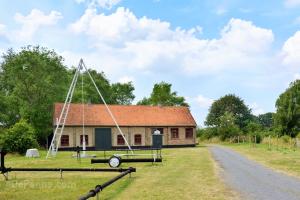
Adinkerke and the birth of De Panne (until 1831)
Long before De Panne existed, people already lived in nearby Adinkerke, behind the dunes.
- Early settlement: people lived around Adinkerke as early as the 5th century BC, and in Roman and Frankish times too people lived here from farming, livestock and fishing.
- Adinkerke: the name Adinkerke appears from the 12th century.
- A pan in the dunes: the name De Panne comes from duinpan, a bowl-shaped hollow in the dunes.
- Sint-Jozefsdorp (1782): Emperor Joseph II wanted to encourage coastal fishing, so around 1782 citizens of Veurne founded a settlement between the dunes and the sea, first called Sint-Jozefsdorp and later Kerckepanne.
- Part of Adinkerke: in 1789 the hamlet became a parish of Adinkerke, and from 1799 it also belonged to that municipality administratively.

Leopold I, fishermen and the first bathers (1831 to 1911)
In the 19th century the little fishing hamlet grew into a seaside resort with a character of its own.
- Pieter Bortier: around 1830 the landowner Pieter Bortier inherited some 650 hectares of dunes, opened a simple Pavillon des Bains in 1831 and worked to improve the poor fishing village.
- Panneschuiten: De Panne had no harbour, so the flat-bottomed panneschuiten were hauled up onto the beach; even so, around 1900 De Panne had the second largest fishing fleet on the coast.
- Sint-Pieterskerk (1860): the first part of the neo-Gothic Sint-Pieterskerk was built in 1860; the tower only followed in 1934.
- The railway (1870): on 5 February 1870 the railway to Dunkirk opened, and soon after came a first kursaal, pavilions, guesthouses and hotels.
- Albert Dumont: shortly before 1900 much of De Panne was laid out to designs by architect Albert Dumont, whose picturesque cottage style is well preserved in the Dumont quarter.
- The sand yacht (1898): on the wide beach the Dumont brothers introduced the sand yacht in 1898, for which De Panne is still famous.
First World War and between the wars (1911 to 1939)
Newly independent, De Panne became one of the last free parts of Belgium in the First World War.
- A municipality of its own (1911): on 24 July 1911 De Panne was separated from Adinkerke and became an independent municipality.
- The royal couple: while the government moved to Le Havre, King Albert I and Queen Elisabeth lived in a villa in De Panne, from where the king led the Belgian army.
- L'Océan hospital (1914): in December 1914 the surgeon Antoine Depage turned the hotel L'Océan into a military hospital behind the Yser front.
- The Royal Chapel: the chapel of Onze-Lieve-Vrouw van de Zee, built between 1906 and 1909, was often visited by King Albert and has been called the Royal Chapel since 1924.
- Onze-Lieve-Vrouwkerk (1930): the neo-Romanesque Onze-Lieve-Vrouwkerk on the Zeelaan is seen as one of the forerunners of the modern churches on the West Coast.
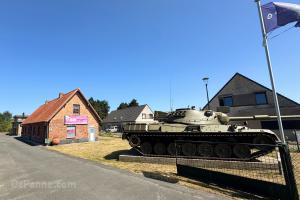
Second World War and reconstruction
In May 1940 the beach of De Panne played a part in one of the best known evacuations of the war.
- Operation Dynamo (1940): at the end of May 1940 British and French soldiers were evacuated from the beaches around Dunkirk, including the beaches of De Panne and Bray-Dunes, where makeshift piers were built from army vehicles.
- Bombed: because of the evacuation, De Panne and Sint-Idesbald were heavily bombed.
- Mass tourism: from the 1950s the villas on the promenade made way for apartment blocks; apart from a few villas, nothing remains of the original seafront buildings.
- Together again (1977): in the municipal merger of 1977 De Panne and Adinkerke became one municipality again, now under the name De Panne.

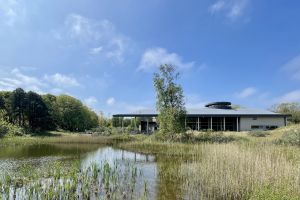
Dunes and nature around De Panne
De Panne is surrounded by dunes that were once hunting grounds for the nobility and are now protected nature.